




With the explosive boom in artificial intelligence, this issue has taken center stage. AI models require an eye-watering amount of computational power compared to traditional workloads, making the search for sustainable infrastructure more urgent than ever.
The Heavy Toll of the Digital Age
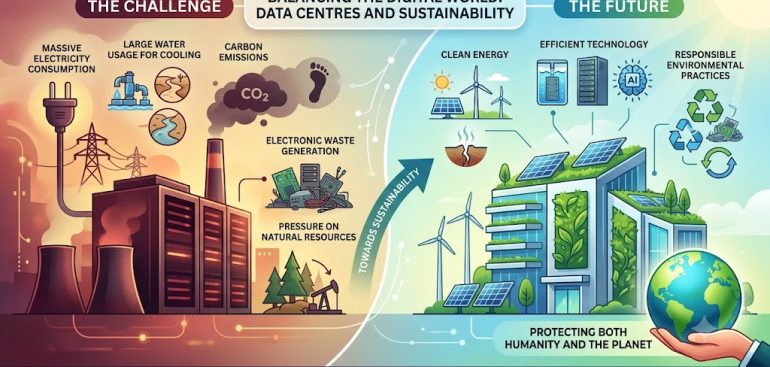
To truly balance innovation with sustainability, we have to look at where the pressure points are:
- The Power Grid Strain: Data centers are no longer just server rooms; they are industrial-scale energy guzzlers. In some regions, they consume a double-digit percentage of the entire national grid’s capacity. A single AI-driven search query can use up to 10 times more electricity than a standard Google search.
- The Hidden Water Footprint: Servers generate immense heat. To keep them from melting down, data centers rely on cooling systems that evaporate millions of gallons of water every day—often in regions already battling severe droughts.
- The E-Waste Avalanche: The race for faster, smarter technology means hardware becomes obsolete at a breakneck pace. The turnover of GPUs and server racks creates a massive wave of electronic waste that is incredibly difficult to recycle responsibly.
Shaping a Greener Future
Fortunately, the tech industry is beginning to realize that ignoring the planet is bad for business. Several major shifts are underway to tackle this digital dilemma:
- Next-Gen Energy Partnerships: Tech giants are moving beyond basic carbon offsets. We are now seeing direct investments in avant-garde clean energy, including geothermal energy and Small Modular Nuclear Reactors (SMRs), to guarantee 24/7 carbon-free power.
- Liquid Immersion Cooling: Instead of blasting giant air conditioners, newer data centers submerge servers in special, non-conductive fluids. This removes heat far more efficiently and drastically cuts down on both electricity and water usage.
- Smarter Code, Not Just Bigger Hardware: Engineers are focusing heavily on algorithmic efficiency—building AI models that achieve the same results using a fraction of the data and computational power.
Ultimately, the goal isn’t to slow down innovation, but to ensure that our digital evolution doesn’t come at the cost of our physical home.